Technologies at Citydent Istanbul
From CBCT imaging to in-house CAD/CAM milling — every stage of treatment is supported by a defined digital workflow.
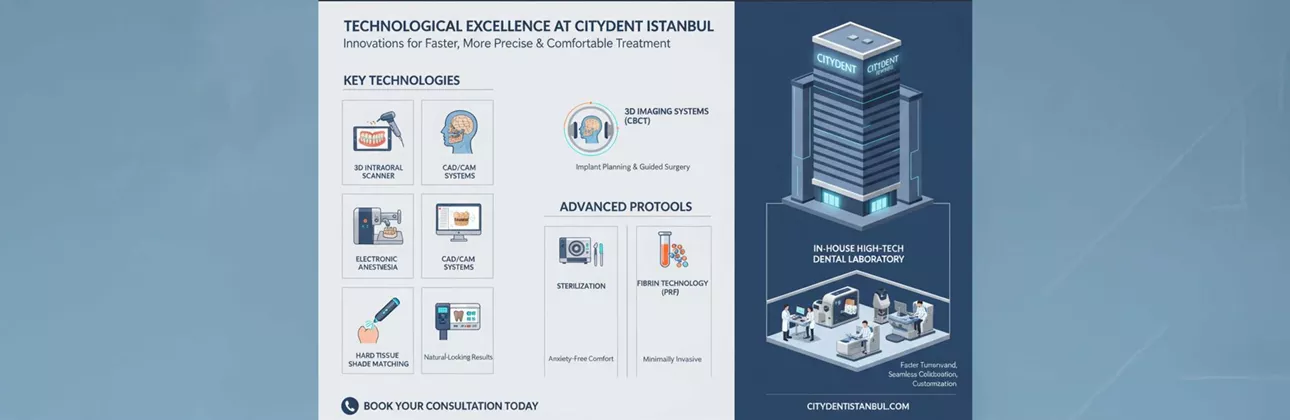
Citydent Istanbul operates around a clearly defined stack of digital dentistry technology Istanbul patients encounter from the first appointment onwards. From diagnostic scanning through guided surgery to final milling, each component serves a specific clinical function — integrated, documented, and applied consistently across cases.
Our Clinical Technology Stack
3D Intraoral Scanning
High-resolution digital impressions replace traditional trays. Stable dimensional data passed directly to CAD/CAM design software.
CBCT 3D Imaging
Cross-sectional anatomy mapping for implant placement, bone assessment, sinus floor height, and nerve canal localisation.
CAD/CAM Milling
In-house zirconia and ceramic milling from validated material blocks. Consistent marginal fit from digital impression to final crown.
Hard Tissue Laser
Precision laser for caries removal, surgical site decontamination, and soft-tissue management in restorative workflows.
PRF Protocols
Platelet-rich fibrin prepared from patient blood on the day of surgery — applied in bone grafts, sinus lifts, and socket preservation.
In-House Dental Lab
On-site laboratory connected to clinical team. Real-time fit adjustments and shade revisions without external courier delays.
3D Intraoral Scanning
High-resolution intraoral scanners replace traditional impression trays in most restorative workflows at Citydent. The scanner captures a digital model of teeth and soft tissue in minutes, creating a dimensionally stable file passed directly to the design system. This removes a manual transfer step that typically introduces measurement error.
The workflow supports zirconia and full-ceramic crowns, inlays, onlays, custom abutments, and provisional restorations. Digital dental treatment planning begins here — with accurate anatomical data rather than an approximation. This is the first step in the digital dentistry technology Istanbul workflow that runs through every Citydent treatment.
CAD/CAM: From Digital Impression to Milled Restoration
Cad cam dentistry Istanbul patients select Citydent for shortens the restorative sequence without compromising fit. Our in-house milling systems work with validated blocks of zirconia, e.max ceramic, and multi-layer ceramics. A digital impression feeds directly into design software; the milled output carries consistent marginal geometry.
This is central to how digital dentistry technology Istanbul operates at Citydent — the scan, the design, and the milling form a single uninterrupted process. For patients travelling for treatment, the in-house setup means real-time quality control without courier timelines.
Advanced dental technology Istanbul clinics increasingly invest in, but in-house CAD/CAM — where the milling unit is on-site — gives the clinical team direct oversight of every restoration before delivery.
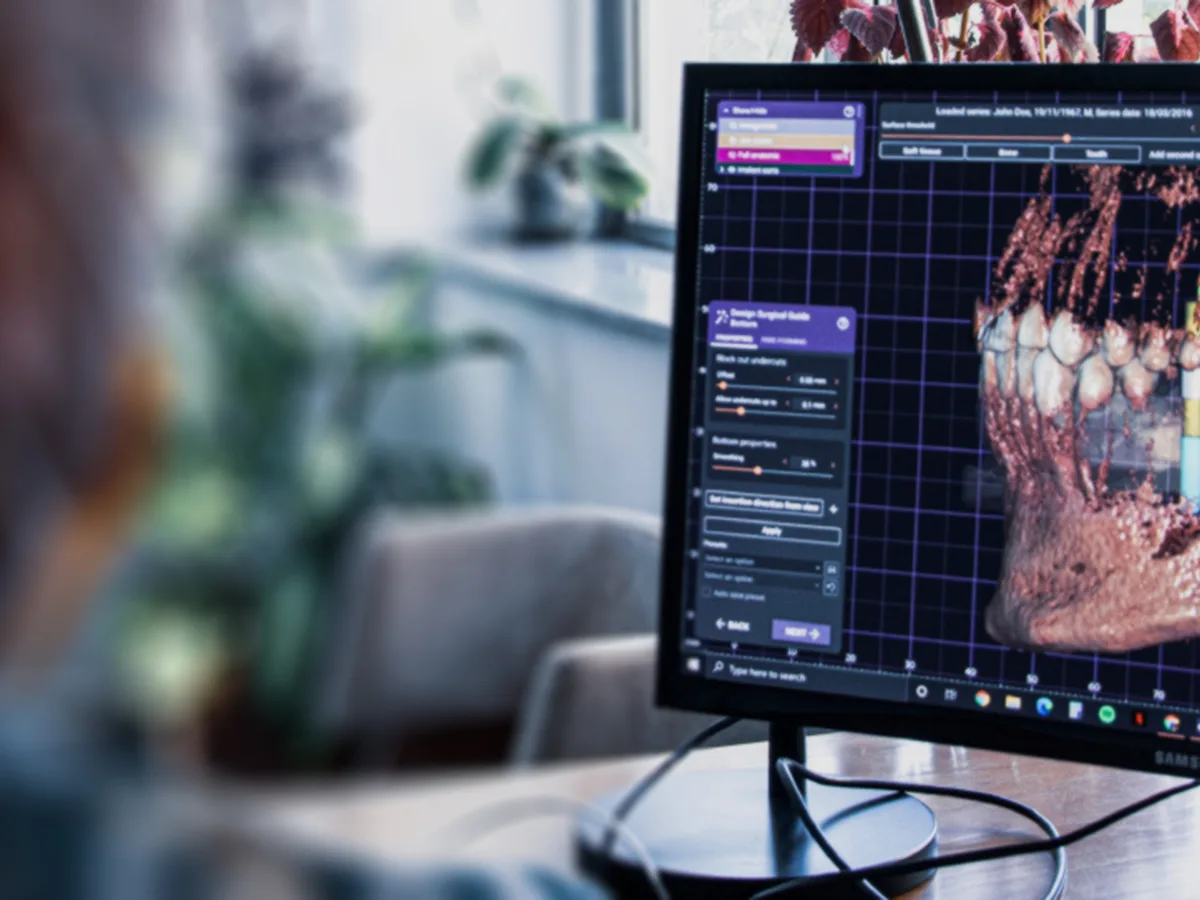
CBCT Imaging and Guided Implant Surgery
Three-dimensional CBCT imaging is used at Citydent where cross-sectional anatomy is clinically required. For implant planning, this means full bone volume, sinus floor height, and nerve canal positions are mapped before any surgical step. The CBCT dataset feeds planning software that enables virtual implant positioning and the production of a custom surgical guide.
For patients considering dental implants in Istanbul, this translates to placement decisions grounded in their individual anatomy. The digital dentistry technology Istanbul treatment teams apply here reduces planning uncertainty and improves surgical predictability. The same imaging session supports diagnosis, guided surgery, and restoration design.
Electronic Anesthesia and Shade Analysis
Computer-controlled anesthesia delivery at Citydent regulates injection pressure. Pressure variation — not the anesthetic itself — is the primary mechanical driver of discomfort during local anesthetic administration. Controlled delivery removes that variable. This is relevant for anxious patients and for procedures requiring extended anesthesia windows.
Shade analysis uses a calibrated spectrophotometer rather than visual estimation. The device measures hue, chroma, and value under standardised conditions. Results are reviewed and confirmed by the patient before any restoration production begins.
Laser Protocols and PRF
The hard tissue laser at Citydent is applied in specific clinical situations: caries removal, decontamination of implant surgical sites, and soft-tissue management for impression accuracy. It is a precision instrument used where its properties offer a measurable clinical advantage.
PRF (platelet-rich fibrin) is drawn from the patient's own blood at the start of surgery and centrifuged on-site. It concentrates the patient's growth factors and is applied during bone graft procedures, sinus lifts, and socket preservation. Use is protocol-driven — applied where clinical evidence supports it. Together, laser and PRF protocols are part of what sets the digital dentistry technology Istanbul approach at Citydent apart from standard clinical workflows.
In-House Laboratory and Sterilisation
The dental technology Citydent applies connects directly to an on-site laboratory. The Citydent Istanbul Dental Laboratory operates within the same building as the clinical team, so technical queries and fit adjustments are resolved without courier cycles. This is a practical advantage for patients with limited visit availability.
Sterilisation follows tracked instrument protocols: single-use materials are disposed of per patient; reusable instruments complete validated autoclave cycles with documented load monitoring.
Technology and Treatment at Citydent
The digital dentistry technology Istanbul visitors to Citydent encounter supports clinical accuracy rather than serving as a display feature. CBCT reduces surgical uncertainty. CAD/CAM shortens restorative timelines. Intraoral scanning eliminates impression variability. PRF supports post-surgical recovery. Each has a specific clinical role.
Patients who want to understand which digital dental treatment methods apply to their case can begin with an initial assessment consultation. The dental technology Citydent applies daily — across implant, restorative, and aesthetic cases — makes Citydent the modern dental clinic Istanbul patients describe when they recommend us.
Related Treatments & Pages
See how digital dentistry technology Istanbul operates in specific treatment contexts.
Frequently Asked Questions
What digital dentistry technology does Citydent Istanbul use?
Citydent uses intraoral 3D scanners, CBCT cone beam imaging, CAD/CAM milling systems, computer-controlled anesthesia, spectrophotometric shade analysis, hard tissue laser, and PRF protocols. These are part of daily clinical workflow for restorative, implant, and aesthetic cases.
Does Citydent have an in-house dental laboratory?
Yes. The on-site Citydent Istanbul Dental Laboratory works directly with the clinical team. Fit adjustments, shade revisions, and urgent remakes are handled without external courier delays — a direct benefit of the digital dentistry technology Istanbul setup at Citydent.
How does CAD/CAM affect my treatment schedule?
CAD/CAM allows zirconia and ceramic crowns to move through design and milling in a compressed appointment sequence. The timeline depends on case complexity, but fewer separate visits are typically required compared to external laboratory workflows.
Is 3D CBCT imaging used for all implant cases?
CBCT is used where clinical assessment indicates diagnostic value — primarily for implant planning, bone graft evaluation, and cases involving sinus anatomy or nerve proximity. The decision is made per patient based on specific diagnostic needs.
What is PRF and when does Citydent apply it?
PRF (platelet-rich fibrin) is prepared from a small blood sample at the start of surgery. It concentrates the patient's own growth factors and is applied during bone graft, sinus lift, and socket preservation procedures where clinical evidence supports its use.